How to Choose the Right Sewage Treatment Plant for Your Site: A UK Guide
If your property is not connected to the public sewer network, you are responsible for managing your wastewater “off-mains.” This important decision can be complicated by UK regulations, varying site conditions, and a range of available technologies.
Choosing the right system requires careful planning. This guide aims to simplify the process and help you select a compliant, efficient sewage treatment plant for your domestic or commercial site in the UK.
Understanding Your Options: Domestic Sewage Treatment Plant vs. Septic Tank
The first step in any off-mains drainage project is to understand the two main types of systems and how modern UK regulations have effectively mandated a preferred choice.
Septic Tanks (The Traditional System)
A traditional septic tank operates on a simple principle: solids sink to the bottom, forming sludge, while the liquid effluent partially separates. However, this effluent is only minimally treated and contains significant pollutants.
Under current UK General Binding Rules (GBRs), a septic tank cannot legally discharge effluent directly into a ditch, stream, river, or any other watercourse. They are only permitted to discharge into a properly designed and installed drainage field (soakaway system), where the ground conditions allow for further treatment.
Sewage Treatment Plants (The Modern Solution)
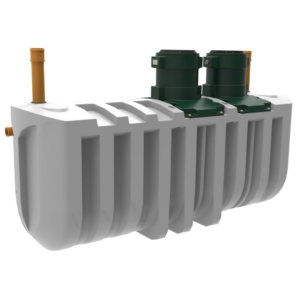
In contrast, a domestic sewage treatment plant (also known as a packaged treatment plant) employs an active mechanical biological process to break down pollutants. This process typically involves aerating the wastewater to promote beneficial bacteria that consume the contaminants.
The resulting treated water can be up to 95% clean. This high-quality effluent means that, in many cases, a modern wastewater treatment plant in the UK can legally discharge directly into a watercourse, provided it meets all General Binding Rules.
When comparing a domestic sewage treatment plant to a septic tank for new installations or replacements, a sewage treatment plant is often the preferred choice, especially if the required ground conditions for a drainage field are not met.
Key Factors for Selecting Your Sewage Treatment Plant in the UK
Once you’ve decided on a treatment plant, several factors will determine the correct size and type of unit for your site:
- Calculate Your Population Equivalent (PE)
The most critical factor is correctly sizing the unit using the Population Equivalent (PE). This does not refer to the current number of residents but rather the maximum number of people the property can reasonably accommodate, as defined by British Water flow and load guidance.
For example, a four-bedroom house is typically sized for six PE, regardless of whether only two people live there. Undersizing the plant may lead to poor effluent quality and potential regulatory breaches.
- Determine the Discharge Location and Type
The destination of the treated effluent dictates the necessary system performance and regulatory requirements:
- Discharge to a Drainage Field (Soakaway): If your ground conditions are suitable (verified by a percolation test), the effluent can be dispersed into the ground. While treatment plant effluent is clean, a drainage field often remains the most secure long-term solution.
- Discharge to a Watercourse: This is only permissible if you use an approved sewage treatment plant, and the watercourse flows year-round. You must ensure that the chosen plant meets the required effluent standards (often 20 mg/L BOD, 30 mg/L SS, and 20 mg/L Ammoniacal Nitrogen, or better)
- Consider Site Constraints and Access
- Location: The plant must be installed at least 7 meters from any habitable dwelling and 10 meters from any watercourse or soakaway, if possible.
- Access: You must ensure easy access for essential annual servicing, as well as for a tanker to empty the sludge (de-sludge) every 6 to 12 months.
Navigating UK Regulations for Your Wastewater Treatment Plant
Compliance with regulations is essential. Using a non-compliant system could lead to fines and legal action from the Environment Agency (EA) in England or its counterparts in Scotland, Wales, and Northern Ireland.
General Binding Rules (GBRs)
In England, most small domestic discharges (up to 2,000 litres per day or up to 50 Person Equivalent (PE) fall under the GBRs. To comply, your wastewater treatment plant must:
- Be correctly sized and installed in accordance with building regulations.
- Be certified to meet the required British Standard (EN 12566-3).
- It should be regularly maintained by a qualified professional.
Environmental Permits
If your system exceeds the GBR limits (for instance, in the case of large commercial sites) or discharges into particularly sensitive environments, you will need to apply for a bespoke Environmental Permit from the Environment Agency. This application process is more complex and requires stricter monitoring.
Building Control
All new installations or replacements of drainage systems must be approved by the local authority Building Control to ensure compliance with structural and location regulations.
Choosing the right off-mains system is a long-term investment for both your property and the environment. By carefully evaluating whether to use a domestic sewage treatment plant or a septic tank, correctly sizing your unit to PE standards, and strictly adhering to UK regulatory requirements, you can ensure a reliable, efficient, and compliant solution.
For expert advice on calculating PE, selecting the right model, and ensuring full compliance for your sewage treatment plant, always consult with an experienced provider. Contact KEE today for assistance choosing the correct sewage treatment plant for your property.