No Mains Access? 5 Solutions for Off-Grid Industrial & Commercial Sites
When developing large-scale industrial parks, remote commercial hubs, or expansive residential estates, it is commonly assumed that utility infrastructure will be readily available. However, many of the most lucrative or strategic development sites lack proper sewer access.
Operating “off-mains” introduces unique engineering challenges, especially when handling high volumes of effluent while adhering to strict environmental regulations. Choosing the wrong off-mains drainage solutions can result in regulatory fines, groundwater contamination, and prohibitively high operational costs.
Here are five effective solutions for managing wastewater on large-scale sites without mains connectivity:
1. Commercial-Scale Package Sewage Treatment Plants
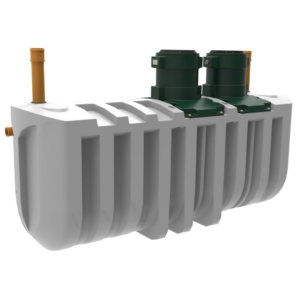
For most large-scale projects, a high-performance sewage treatment plant is the gold standard. Unlike simple holding tanks, these systems utilise biological processes, such as Rotating Biological Contactors or Aerated Fixed Film technology, to treat wastewater to a level where it can be safely discharged into a watercourse or soakaway.
- Best for: Business parks, hotels, and large housing developments.
- Key Advantage: Fully automated systems can handle fluctuating loads, ensuring compliance with the Environment Agency or local regulatory standards.
2. Pumping Stations for Distant Sewer Access
Occasionally, a main sewer exists but is located uphill or at a significant distance from the site. A private pumping station serves as the heart of your infrastructure, collecting waste in a wet well and “lifting” or “shoving” it through a rising main to reach the nearest point of sewer access.
Critical Requirement: These systems need a rigorous planned maintenance schedule. A pump failure on a large-scale site can quickly lead to backups and environmental overflow.
3. Specialised Systems for High Water Tables
In coastal areas or low-lying floodplains, a high water table can compromise traditional drainage solutions. If the groundwater level is high, standard soakaways may fail because the soil is already saturated.
In these cases, developers must employ “shallow dig” tanks or specialised mounded-discharge systems, which prevent groundwater ingress (which could overwhelm a treatment plant) and ensure the safe dispersion of treated effluent without pooling on the surface.
4. Reed Beds and Tertiary Treatment
For sites with particularly sensitive environmental receptors, a primary sewage treatment plant can be paired with a reed bed. Reed beds act as a natural secondary filter, further reducing suspended solids and Biological Oxygen Demand (BOD).
Benefit: They provide a sustainable, “green” aesthetic for commercial sites aiming for high BREEAM ratings while offering an additional layer of protection against discharge non-compliance.
5. Vacuum Sewerage Systems
In sprawling sites with flat terrain or challenging rocky ground, where deep trenching for gravity sewers is cost-prohibitive, vacuum sewerage systems offer an innovative alternative. These systems use differential air pressure to transport waste to a central collection point.
Best for: Large industrial complexes or sites where traditional gravity pipework cannot be easily installed.
The Importance of Planned Maintenance
Regardless of the technology chosen, off-grid systems represent “live” biological and mechanical assets. In a large-scale project, even a minor mechanical fault can escalate into a site-wide crisis within hours.
A planned maintenance contract is essential to ensure:
- Regulatory Compliance: Regular sampling demonstrates that your discharge remains within legal limits.
- Asset Longevity: Professional servicing of blowers, pumps, and bearings can help prevent premature, multi-million-pound replacements.
- Emergency Prevention: Identifying a high-level alarm or a failing motor during routine checks is significantly cheaper than an emergency tanker call-out at 2:00 AM.
Conclusion
Developing a site without sewer access is entirely feasible with the right engineering partner. By selecting the appropriate off-mains drainage solutions and committing to a proactive service regimen, you can transform a remote location into a high-functioning, compliant, and sustainable asset.
If you’re navigating a complex off-grid project, contact KEE to consult with our experts on the design, installation, and long-term maintenance of your wastewater infrastructure.